Friday, November 4, 2011

1st weekend trip- Pondicherry

A couple weeks ago, we went to Ponicherry for a long weekend.  On the way we visited some really cool stone temples.  We also went to a crocodile farm.  All three of our hotels had a pool and we're located right on the beach.  The first was the nicest resort I've ever been to.  The pool even had a swim-up bar and we got to swim in the Bay of Bengal.  The second was a really cool eco friendly resort with a really neat atmosphere and we got bikes to ride around the resort.  The last was actually in Pondicherry so we were able to walk to places to shop.  Pondicherry is a Union Territory in the South and it was a really cool place to visit.  Because of French influence, some of the streets we walked down looked a little like Europe and the area did not seem as crowded or polluted as the other places in India that we have visited.
At the Dune Eco Resort

On the balcony of our hotel in Pondicherry

At a rock temple- can you spot the goat?  (there are always goats around the temples)
A man kept following us around at this temple trying to insist that we pay him to be our tour guide but our teacher kept telling him to go away.  That didn't discourage him though, he literally followed us until we left.

We spent a day in Auroville.  Auroville is a unique city in Pondicherry.  This is a little introduction from the website:
"Auroville wants to be a universal town where men and women of all countries are able to live in peace and progressive harmony above all creeds, all politics and all nationalities. The purpose of Auroville is to realise human unity."
At first we thought it was a cool place but the longer we stayed there, the weirder it got.  Some of our group is convinced that it's a kult I think.  There are a lot of good things about the place.   Community is emphasized and living sustainably is really important.  But the society is based on having no religion but meditating and doing what "the Mother would want you to do".  They spent a ton of money on this huge gold ball that they go inside to meditate.  It is suspended off the ground.  It's crazy how much they spent on that when they have so many other plans for the town that they need to finance. They don't let tourists inside except during certain times and we weren't supposed to take pictures once we were inside the gate surrounding it but we snuck pictures anyway.


 We also visited a huge lignite mine on our trip.  It was amazing how big it is and in the U.S. it is really hard to get permission to go down into a mine.  We got to take a bus down into the mine.  The drive was a little scary to me but it was neat to see.
Mary and I at the Mine

 On the way back to Chennai we visited a mangrove forest and rode on a boat.  It was nice to see green and no visible trash and pollution (I'm not sure about the quality of the water) after being in so many dirty crowded cities.  The boat ride through the mangroves reminded me of Florida which I really enjoyed.  A lot of people compared it to the Everglades.

As good as it was to get back to MCC after the trip, I enjoyed being spoiled at the hotels.  All offered American food which was such a nice treat and the hotels were so nice.  I will miss MCC but I'm looking forward to the last 4 weeks of the trip when we are in hotels.


Tuesday, November 1, 2011

Daily Life at MCC

While at MCC, we are attending lectures by local Indian professors on the weekdays.  A typical weekday consists of 9 AM lecture, tea and cookie break, 11 AM lecture, lunch, and then free time during the afternoon with another tea and cookie break and then dinner.  Usually in the afternoon we go to the market and/or play ultimate frisbee.  In the evenings we usually hang out on the porch of the guest house and just read or talk.  We do have some papers to be working on but it has been hard to be motivated because they are all due at the end of the trip.  After the first 6 weeks of intense work and classes at Furman, daily life here is so relaxing and has been a much needed break.  I don't know how I will get back to the normal Furman class routine next semester.  On the weekends we usually take road trips.  The first weekend we went to Pondicherry, last weekend we just went into Chennai, and this weekend we went to Trichy. 
 
Hanging out on the porch at MCC
 
The market is about a fifteen minute walk from campus.  We go several times a week to look around and shop.  The market is an overwhelming place.  It is so crowded, polluted, and smelly.  There are people with fruit stands and other shops all along the streets.  On the way to the market there is a hot musty tunnel that we have to go through and people even have stuff set up on the ground to sell.  The other day the ground of the tunnel was flooded and we had to walk through the most digusting water ever.  It was brown and trash full of floating trash and debris.  I can barely handle passing through that place so I have no idea how people set up camp there all day.  In the tunnel and the rest of the market, there are also a ton of beggars.  Many of them are are missing an arm or leg and it is kind of hard to look at since I am squeamish about those things.  The other day we walked down the aisle of the market where fish are sold.  The smell was absolutely awful and there were flies everywhere.  The market makes me not want to eat any fish, vegetable or fruit served in India.  We aren't allowed to eat most fruits here anyway and I try to forget the images when I eat meals. 
 
At the maket- this doesn't even completely capture the craziness


Our entire group of 20 plus 2 drivers and 2 or 3 or Indian people all fit into 2 little rickshaws!  This picture is before Suresh and I even got on.  The Indians just keep piling people in, I still don't know how we all fit.  We have seen up to 5 people on motorbikes and the buses are always packed with people literally hanging out the sides. 
 
Other observations:  Several times a day the power randomly goes out for a few seconds but comes back a few seconds later.  Even at a really nice hotel where we stayed, the power flickered out at times.  While walking on the beach we saw a really pretty evening wedding with Christmas lights but the power kept cutting off randomly during the wedding.  Luckily though it doesn't last long.  Another thing I have noticed is that Indians seem to have no concept of time.  Our lectures almost always run way overtime and it doesn't phase them.  At a show that we went to, our teachers told the dancers that we only had 45 minutes but they just kept on performing and finally someone had to interrupt them and cut them off.
 
Food is still a major struggle.  I'm not having trouble finding enough calories but the quality of my diet has gotten pretty bad and I'm starting to get tired of the same rice and junk food all the time.  I absolutely cannot handle the spice though.  Also, I don't know what is wrong with them, but Indians apparently do not appreciate the value of chocolate.  We went to a sweet shop with tons of different sweets, but not one single one contained chocolate!  Luckily the Pic N' Pack, a little convenient store down the road has a few things like kit kats and oreos to keep me alive and sane.  Also, the ice cream is really good here.  Every time we eat out, our professors let us order ice cream which is nice.  My only complaint is that the serving sizes are so small.  I think my family would probably laugh if they saw the little cups, but the ice cream is pretty rich and cheap.  I'm usually lucky enough to get an extra serving from someone who doesn't like theirs too.  The hotels that we've been to have been a lifesaver because all have offered American food and nonspicy options! 
 
Last Friday, we took a day off classes and went to explore more rural areas.  The entire town came out to see us practically.  They were so excited that we had stopped by.  We observed weaving which was pretty amazing.  We also saw a potter and then watched a man roll beedis, which are handmade, unfiltered cigarettes.  Our teachers bought a few for us to try.  We also stopped by a rice paddy field.  That evening we ate at our teacher, Suresh's, inlaws house and they arranged for us to see a play.  The play involved extravagant costumes and told the story of Krishna, a Hindu god.  The entire play was in Tamil. 
 
 
 Picture of me smoking a beedi- this is for you Mom cause I knew you'd be proud :)

Sunday, October 23, 2011

1st Impressions

The trip started at 7:30 AM on Thursday when we met on campus to head to the Greenville airport.  I was nervous that I had forgotten something important but felt so accomplished that I fit everything for 9 weeks into one suitcase, a carry-on, and a backpack.  Well apparently it wasn't an accomplishment.  I cannot believe how little everyone's suitcases were.  It is unbelievable, yet they made fun of me not believing it was possible to pack so much.  I still have no clue how they did it.  My checked bag was 16 lbs overweight and my professor ended up putting the extra weight in his bag.  How embarrassing!  Then my carry-on got checked because it was too large.  I was a little worried that my trip was not off to a good start and afraid that everyone was going to think I was so high maintenance and caused so much trouble.

Thankfully, the trip was fairly smooth after the baggage issues and all of my baggage made it to India.  The traveling was exhausting though and I only slept about 3 hours of the total 36 1/2 hours we were traveling.  We were supposed to arrive in Chennai about midnight Friday (India time) but our last flight got delayed leaving and then landing.  We were approaching landing when the pilot found out there was a broken down airplane on the runway so we ended up circling above the airport for about 40 minutes.  We started running out of fuel so we had to fly to Bangalore and refuel at that airport.  We waited at the airport a couple hours until the Chennai runway was clear and finally flew back and landed in Chennai.  We didn't end up arriving to Madras Christian College (MCC) where we are staying until about 5 AM.   Our professors wanted us to stay up during the day so that we would adjust to Indian time.  After sleeping so little on the plane, making it through Saturday felt like a marathon. 


This is Joe, Eric's and my friend who sat beside us on the plane.  He even invited me to the park by his house in Michigan!  Bocca Beezeus! (thats his favorite expression)

Upon leaving the airport we were immediately immersed into the Indian culture.  I had seen movies and heard that roads were crazy but I did not think at 5 AM it would be so bad, and I was not prepared for such immediate immersion.  As we walked out of the airport, the heat and humdity hit us and tons of Indians stood outside of the gate, and they all stared as we walked to our van.  It smelled pretty awful (like really bad body odor).  Cars were honking like crazy and we saw people, motorbikes, cows, buses, all on the same busy road.   
I had heard that we would be stared at but I thought there would be other tourists.  It turns out we are pretty much the only white people in Tambaram (town that we are staying in where Madras Christian College is near Chennai).  Everywhere we go people take pictures of us or stare, wave, or blow kisses. 
The heat and humidity here are pretty rough.  I'm not complaining that I get to miss two months of cold weather, but it's definitely even hotter than I expected.  Just walking outside I pretty much get drenched in sweat.  We are lucky to get our laundry done, but our clothes are hung to dry. It really wears on my clothes.  I've pretty much accepted that I'm going to be looking rough everyday, and that my clothes will be ruined by the time I leave.
I had joked that the food would be too spicy for me and that food was my biggest fear about India.  I didn't realize how accurate this was.  The food is killing me.  EVERYTHING is spicy.  Even at breakfast!  And, it makes it a million times worse that everyone in my class loves the food.  I pretty much live off of rice, naan, peanut butter, and cookies.   
MCC, where we are staying for the first five weeks is a college campus in Tambaram near Chennai.  The campus is wooded and so relaxing and peaceful.  It is crazy that it is in the middle of the fourth largest city in India.  While on campus, it is like a refuge from the hectic chaos and nastiness of the city.  One travel book described it as one of the dirtiest places to live.  But MCC is an exception.  While sitting on the porch of our guest house, we can see deer wandering the campus.  The campus also provides a great place for running and ultimate frisbee with the class which is really nice.  I was so overwhelmed when we first got off the plane that I didn't know if I could handle nine weeks here.  I started panicking a little but as soon as we arrived on campus, I was immediately at ease.  I literally feel like we "enter India" when we walk out the gates and leave India when back on campus.  As soon as you leave the gate, you reach a busy road where cars are blaring horns, and the pollution hits you.   
Our home at MCC


Bucket bath at MCC
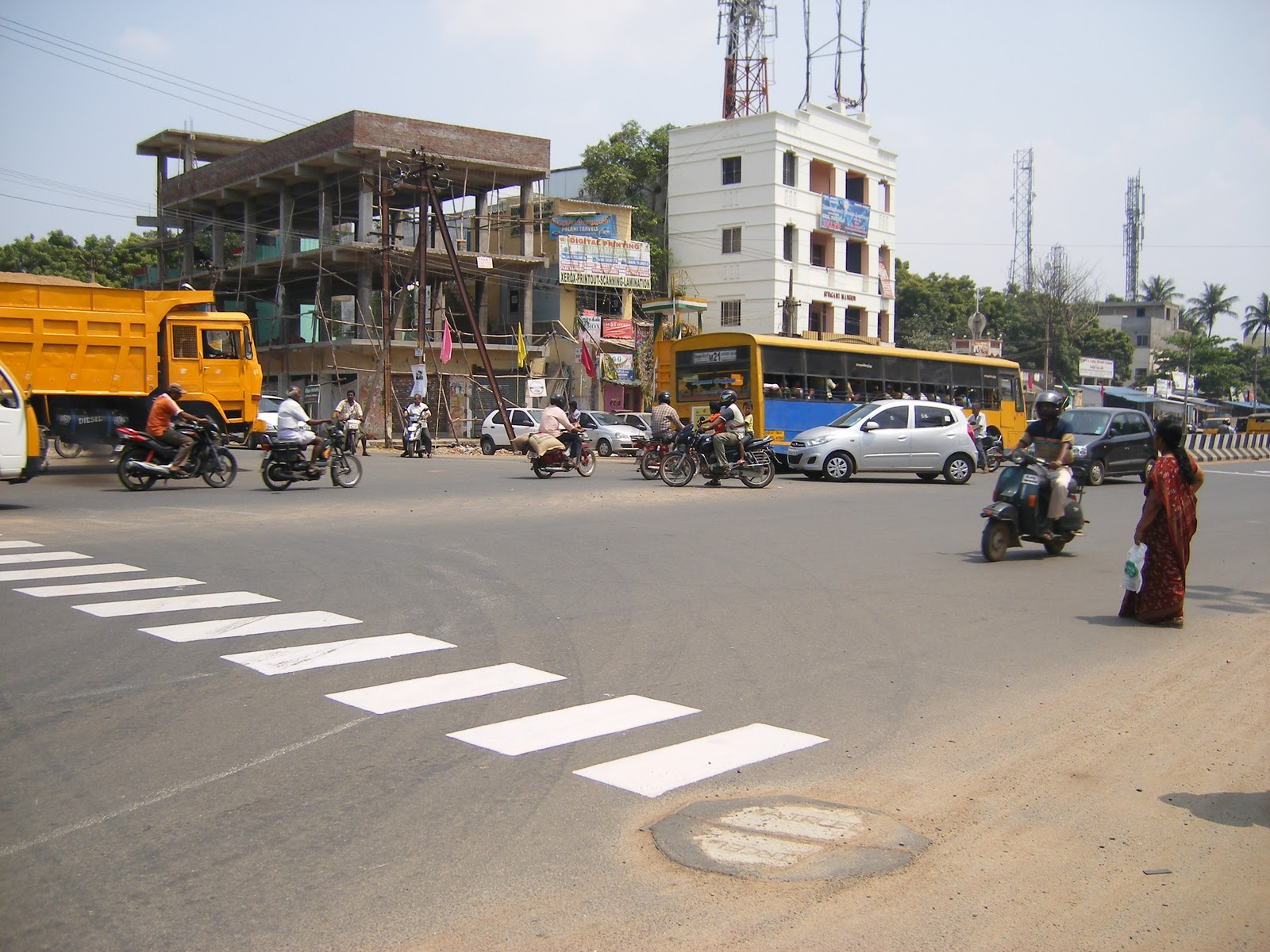
The first day after no sleep for 40 some hours, a few of decided to explore around the campus by ourselves.  One of the guys decided it would be fun to cross the street but we had had no instruction from our professors about how to go about it.  It was so scary.  Cars, motorbikes, and buses were flying by from both directions, and there are no crosswalks.  After chickening out a few times, we finally sprinted across, barely making it.  Then we felt ridiculous as we watched an old Indian woman stroll casually across right in front of traffic like it was no big deal.
Crossing the street
After two weeks, I have already gotten used to the craziness of the roads and even have ventured out with only my friend Amanda.  We just causally walk out "into India" to go to the market or store like its an everyday occurence for two American girls to stroll the streets of India. 
Since then we have also seen the opposite extreme of India while staying at some nice resorts, which I will talk about in my next blog.

Thursday, September 29, 2011

Urbanization and Air Pollution

             Air pollution has become a huge problem around the world.  Urban areas, particularly in developing countries, are especially affected by pollution.  Air pollution is not only extremely harmful to the environment, but it has significant health consequences as well.  Increasing vehicular traffic is one of the largest contributors to increasing air pollution.  With such a huge population that continues to increase and with increasing rates of urbanization, India is significantly affected by air pollution and will have even more problems in the future if the issue is not addressed immediately.
    
                According to the World Health Organization, air pollution is “substances put into the air by the activity of mankind into concentrations sufficient to cause harmful effects to health, property, crop yield or to interfere with the enjoyment of property” (Nagdeve, 2004).  The composition of mixtures of air pollutants varies by region based on differences in transportation mode and traffic, economic and social factors, power generation, and differences in other human activities.  However, mixtures from all areas include some common gases and pollutants such as sulfur dioxide, nitrogen oxides, carbon dioxide, and ozone.  Most pollution goes into the outdoor environment, but people can be exposed to pollution both indoors and outdoors (Cohen et al., 2004).
                Increases in amount of exhaust released from automobiles, wastes from industries, and burning of fossil fuels are the main causes of air pollution. (Nagdeve, 2004).  Lack of planning is also a major factor contributing to air pollution.  Traffic congestion and location of industries often would contribute less to air pollution if cities had been better planned.  Poor sanitation and drainage and large amounts of garbage increase amount of air pollution as well.  India spends over one billion dollars per year on urban air pollution (Nagdeve, 2004).
Data from the World Health Organization indicate that air pollution is responsible for about 673,000 deaths per year in India (Nagdeve, 2004).  In their study on air pollution and mortality, Dockery, et. al found that mortality rate was related to levels of pollution in the air in a particular area.  Amounts of inhalable small particles were more closely related to mortality rates than other variables such as amounts of sulfur or nitrogen dioxide.  There was a relationship between all-cause mortality and air pollution as well as cardiovascular and respiratory diseases and pollution.  Air pollution was positively correlated with mortality rates among all groups including non-smoking people and those not exposed to occupational pollution.  People of all ages, sex, and body-mass indexes were affected by air pollution (1993).  Even people who do not die from air pollution may experience negative effects of it such as eye irritation (Cohen et al., 2004).  Other problems associated with air pollution include respiratory damage, heart disease, and disease of the lungs (Nagdeve, 2004).
With its current problems and increasing population and urbanization, it is crucial that India make huge strides to improve the air quality of the nation particularly the urban areas.  In his article, Urban Air Pollution and its Influence on Health in India, Nagdeve states that this task must be a priority and that the government as well as local leaders must take part or it will eventually no longer be possible for humans to live on the Earth.  He says that public transport should be invested in, in order to decrease personal vehicular traffic and that research should be done on vehicle technology (2004).  Not only should public transport systems be improved and more efficient cars designed, but incentives should be given to people who choose these more environmentally friendly options.  For example, incentives could be given to make it cheaper to purchase more fuel efficient cars.  Infrastructure should also be put in place to encourage people to use active transport.  Infrastructure such as sidewalks and bike lanes make walking or biking safer and more convenient.  Active transport would not only reduce the amount of vehicular traffic and air pollution, but it would also increase physical activity levels in India.  Physical activity is important in the prevention of many health problems including obesity, heart disease, diabetes, and cancer.  This is especially important because studies have found that obesity rates increased in India with the increase in urbanization.  As India continues to become more urbanized, the rates will only increase if prevention efforts are not taken.  Providing infrastructure for active transport and public transport would be much easier for India to incorporate now as cities are planned and built, than later when the cities are already built and crowded with people.  The United States suffers from not realizing this before.  With chronic disease as the leading cause of death and the obesity epidemic in the U.S., the country is realizing that methods to increase activity are crucial.  However, since cities were built without this or the environment in mind, it is a massive project that requires a lot of time, money, and inconvenience to incorporate infrastructure now.  As a newer country to the urbanization trend, India should learn from the United States’ mistake and plan their cities to allow for more physical activity and less pollution to the environment.  India could reduce the amount of damage to the environment and prevent an obesity epidemic by planning its cities appropriately as they continue to emerge and grow across the country.     
            
Cohen, et al.  2004.  Urban air pollution.  Comparative Quantification of Health Risks, Vol 2.  Geneva World Health Organization, 1353-1433.

Dockery, et al.  1993.  An association between air pollution and mortality in six U.S. cities.  The New England Journal of Medicine, 329, 1753-1759.  Retrieved from http://www.nejm.org/doi/ful/10.1056/


Thursday, September 22, 2011

Wind as a Renewable Energy Source for India


To provide for such a large and growing population, India needs to find sustainable methods for producing enough energy for the entire population.  Because so many energy sources are limited and harmful to the environment, it is essential that India invest in renewable, environmentally friendly solutions to its energy need. 

In the Indian Renewable Energy Status Report, Arora, Busche, and Cowlin, state that India has lots of potential to use renewable energy to meet the country’s growing energy demand because of several factors.  Abundant natural resources in India make it possible for the country to use renewable energy sources.  For example, India has the world’s largest amount of solar radiation.  It also has potential for wind farms both on land and offshore because of high wind velocities.  Renewable energy is also important in India for decreasing dependence on fossil fuels from other countries.  Because fossil fuels are nonrenewable, the prices are expected to increase due to competition among nations.  Having other sources of energy would prevent India from being a victim of the price increases.  Another reason renewable energy is a promising solution for India is that it can provide energy to both rural and urban areas including impoverished areas.  In addition, renewable energy is attractive for India because it can help the country achieve its goal to reduce carbon emissions in order to decrease climate change.  Working towards using more renewable energy sources would also help India as it strives to become a word leader for renewable energy (Arora, Busche & Cowlin, 2010). 

Wind is a natural, renewable energy source that provides one of the most promising solutions to India’s energy goals and some action has already been taken by the country in this area.  As of 2009, India had the fifth highest installed wind capacity in the world (Arora, Busche & Cowlin, 2010).  The potential capacity for wind in India is about 45,000 MW (“Renewable Energy”, 2007).  However, efficiency of India’s wind farms needs to be improved (Arora, Busche, & Cowlin, 2010).  Only about 12 GW of India’s installed wind capacity had been used in 2010.  The Indian government has provided incentives to increase wind power use in the country (“Renewable Energy”, 2007).

Wind power reemerged as a promising energy source in the 1990s.  This has continued into the 21st century as governments make policies in order to be more sustainable and cut down on carbon emissions.  Present day wind turbines operate by converting power in wind into electricity and the turbines are connected to an electrical network to provide electricity.  An upward force on the shaft of the turbine due to wind that causes the shafts to spin produces the power that causes wind to convert to electricity.  Wind turbines have a lot of potential applications.  They can store energy, produce fuel, upgrade fuel of lower energy, and provide distributed generation (Manwell, McGowen & Rogers, 2009).

While wind energy shows a lot of potential for India’s future, there are some negative aspects of wind farms.  Wind farms can destroy wildlife.  Many birds and bats have been killed from flying into the structures.  The public has also complained about wind farms because of the noise that they cause.  Many people believe that wind farms are very unattractive and not aesthetically pleasing (Macfarlane, 2007).

In order to meet the demands for energy, I believe that India should invest heavily in renewable energy sources that do not provide as many damaging effects to the environment as fossil fuels.  India should utilize its natural resources in order to provide energy from sustainable sources.  Wind energy should particularly be invested in and India should meet its potential for wind power and make use of all its installed wind capacity.  The negative aspects of wind power should be considered but it must be acknowledged that the cons are minimum in comparison to the benefits including the decrease of carbon emissions and climate change that it will allow.  There is essentially no perfect solution.  Any energy source will have both pros and cons and in comparison to other sources, wind power has much more minimal negative or damaging aspects.  In order to minimize the noise and negative aesthetic impact of wind power, serious planning should go in to where wind farms are placed.  If possible, farms should be located in areas that are already not particularly aesthetically pleasing and not too close to personal property where noise would be a major disturbance.  Tracking bird migration should be performed so that wind turbines can be temporarily stopped during times of migration.  Making the blades shorter might decrease the chance that a bird hits them as well.   Education to citizens about the benefits of wind energy and the harm from alternative sources is also important.  People would probably be less likely to complain about noise and aesthetics if they realized that it was better than the alternative.  If they knew that it was helping to prevent the use of fossil fuels and thus air pollution and global warming and possibly even prevent increases in energy costs or conflict associated with limited supplies, the people would probably be more receptive to the idea of wind power. 

Manwell, J., McGowen, J., & Rogers, A. (2009). Wind energy explained: theory, design, and application. (2nd ed.). John Wiley & Sons, Ltd.: Retrieved from http://reader.eblib.com.libproxy.furman.edu/(S(h3xk2kzmm5ew3e4m0x444sl2))/Reader.aspx?p=589269&o=764&u=A4dItgKXX8g%3d&t=1316735526&h=0FA4449DDBF891182A91F8D6DBD1F51E5A351732&s=10809787&ut=2378&pg=1&r=img&c=-1&pat=n#


Friday, September 16, 2011

Food Security in India


With over one billion people, and a large percentage of those people living in poverty, India faces a great challenge of providing food security to the entire population.  Food is an essential basic need for all people and thus, must be accessible and affordable to all in order to prevent hunger, starvation, or malnutrition.  In fact, chronic hunger and malnutrition rates in India are among the highest in the world (Swaminathan).

India suffered from severe food shortage in the 1960s.  This inspired the Green Revolution which targeted increasing several specific crops including wheat.  The revolution was successful at bringing India out of the shortage and the amount of food produced in India exceeded the population growth rate until the 1990s.  However, economic liberalization in the 1990s caused food production to slow relative to population growth.  Collapse of the rural credit system that occurred with economic liberalization was responsible for this.  Decreases in tariffs and the elimination of restrictions on imports also caused prices to increase for producers in India.  As a result, food security is once again an issue for India today (Swaminathan).

Some people believe that food security issues especially in a heavily populated country such as India are caused by a shortage of food due to high population growth.  However, it is actually a matter of how the food is distributed and who controls the production of food that creates security issues rather than population growth as Madhura Swaminathan argues in his essay, Population and Food Security (Swaminathan).

Swaminathan states that there are two main issues that should be given priority for addressing the food security issues that India faces today.  The first is to guarantee ample food production to meet the needs of the country’s large population.  Because it is so large, Swaminathan argues that India cannot depend on trade for food but that domestic production should instead be the main insurer of adequate food for the population. The second issue that is important for India to address is hunger and malnutrition.  Simply having enough food for the country is not adequate to eliminate these concerns.  Without proper policies and programs, many people do not consume adequate amounts of food or quality food containing essential nutrients due to financial or physical inaccessibility (Swaminathan).

In their paper, Anatomy of a Global Food Crisis, Pedro Conceicao and Ronald Mendoza also discuss the importance of self-sufficiency in food production for a country.  If a country has either a net food import or a net food export, it is vulnerable to changes in food prices.  Low-income countries are particularly vulnerable to inflation in prices.  These authors also state, as Swaminathan did, that merely having an abundance of food does not necessarily eliminate food security issues.  Large amounts of food production do not address the issues related to food ownership and accessibility.  Poverty, inequality, and financial crises intensify issues related to food ownership and accessibility.  The poor are most vulnerable to consequences of inadequate food distribution policies (Conceicao & Mendoza, 2009).

One method to ensure access to food for all people is to have an active and functional public distribution system (PDS).   In the past, the PDS was somewhat more effective but in recent years it has been exchanged for policy related to economic liberalization motives.  The most recent PDS has not been successful because many people have been excluded, price inflation has not been controlled, and grain has been diverted elsewhere in some cases instead of making it to the consumer.  Swaminathan suggests that universal PDS, which regulates prices and entitlements to all families, needs to be reinstituted (Swaminathan).

According to the National Commission on Farmers (NCF), public policy is vital to protect domestic farmers from increasing prices.  Not only is it important to keep prices down for farmers, but it is important for consumers as well.  In India, many rural families spend over half of their income on food already so inflation would place many households under serious hardships.  Policy is also needed to improve research in the agricultural sector.  Investment in the rural infrastructure and agriculture is crucial as well (Swaminathan).  Conceicao and Mendoza also emphasize having policy coherence in order to solve food security issues (2009).

Despite the large population and the issues that India faces such as poverty, Swaminathan argues that the problem of food security can be feasibly achieved.  He believes that self-sufficiency is key meaning that enough food must be produced domestically to provide for the amount of food needed for consumption in India.  Public policy and investment are crucial for ensuring this self-sufficiency as well as preventing hunger and malnutrition.  A functional public distribution system for India can play an important role in this as well (Swaminathan).


Conceicao, P. & Mendoza, R.  (2009).  Anatomy of the global food crisis.  Third World Quarterly, 30 (6), 1159-1182.

Saturday, September 10, 2011

Maternal Mortality in India and its Link to Poverty


Despite efforts to improve maternal and child health, maternal mortality continues to be a major problem in India.  India has the highest maternal mortality ratio in the world.  In fact, 20% of all maternal mortalities worldwide occur in India.  Each year, approximately 117,000 women die in India as a result of pregnancy, childbirth, or puerperium (Salvi, 2009). 
It is a shame that maternal mortality is such a prevalent issue in India when maternal mortality rates are so low in most developed countries.  Most deaths associated with childbearing are preventable making it even more tragic that so many Indian women lose their lives while in labor or shortly after. 

Public awareness about the necessity of addressing the maternal mortality problem began with India’s first five-year plan.  However, there has been a lack of focus that has lead to many different unorganized strategies and programs that have not been effective rather than focusing on one consistent and successful plan for interventions (Ved).

The fifth Millennium Development Goal created by the United Nations was to improve maternal health.  The targets of the goal include reducing the maternal mortality ratio by 75% and providing universal access to reproductive health by 2015.  The world is not on track to reach this goal and India’s lack of significant improvements in maternal mortality is a major contributor to the potential failure of reaching the goal (Salvi, 2009).

Although India is significantly behind the millennium goal and maternal mortality in the country is still so high, some slow progress has been made.  Both maternal and child mortality ratios have decreased slightly in the country.  Two national projects, Child Survival and Safe Motherhood (CSSM) and Reproductive and Child Health-I (RCH-I), have contributed to this marginal improvement.  Both programs are aimed at improving maternal mortality ratios through greater access to antenatal care (ANC), safer institutional and domestic delivery services, access to safer abortions, post-partum care, and access to centers that could provide Emergency Obstetric Care (EmOC) (Ved).

One reason that progress has been so slow is related to India’s rapidly growing population.  Improvements in childbearing safety have been cancelled out by the expanding population.  Most of the growing population is poor which escalates the problem.  Even with such an extremely low wage cut off for the poverty line, 300 million Indians are considered to live in poverty (Salvi, 2009).

India’s high rates of poverty play a major role in the poor maternal mortality ratios and lack of access to health care by many Indian women.  According to Rajani R. Ved in his article on Reducing Maternal Mortality, poorer women as well as rural women and women who had fewer than twelve years of education did not receive near as much information or services related to antenatal care as other women in India (Ved).  Many women give birth while underweight or malnourished, which increases their risk during labor or recovery.  Over half of the women in India are iron deficient (Salvi, 2009).

A large percentage of births in India occur in the home and without the assistance of a trained medical personnel (Salvi, 2009).  Lack of access often related to poverty is usually the reason for so many births occurring without a skilled attendant.  If skilled medical attendants and institutions where women could give birth were more accessible, many lives could be spared, as childbearing would be much safer.  Many of the mortalities that occur could be prevented if a trained medical person was present.

Other contributors to the high maternal mortality ratios in India include lack of education of many and young marriages.  It is an Indian tradition to marry extremely young especially for the girls who do not complete much schooling.  The legal age for marriage in the country is actually 18 years old but most do not observe this law.  The median age of a woman’s first time giving birth is about five years lower in uneducated females compared to those who are educated.  When girls get married young, they usually have babies at much younger ages.  Lack of education and lack of access to contraception in India cause many of the girls to get pregnant early.  Younger girls are at increased risk for childbearing complications or death because their bodies are often not fully developed when they get pregnant (Salvi, 2009).

It is evident that the current programs to reduce maternal mortality in India have not been sufficient.  These programs need to be better implemented and more actions need to be taken so that women can give birth more safely.  Such a preventable cause of death should not be so prevalent as it is in India today.  Women need to be given better access to education and access to a medical institution or trained assistance during labor.


Salvi V. Maternal mortality in India: The true killers. J Postgrad Med 2009;55:1-2